- Determine the frequency of a waveform coming from a microphone (the input frequency).
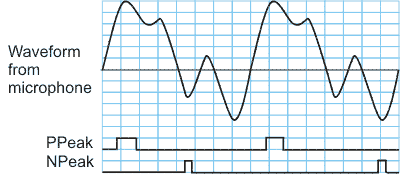
- The waveform can be a complex one, such as that shown below.
- Depending on input from the user, output a squarewave that's the same frequency as the input frequency, or output frequencies one or more octaves above or below the input frequency.
When a frequency is one octave above a given frequency, it is twice the frequency. Two octaves above is a frequency four times the given frequency.
When a frequency is one octave below a given frequency, it is half the frequency. Two octaves below is a frequency that is one quarter of the given frequency.
In the waveform immediately below, some analog circuitry (using op amps) has created a PPeak pulse that goes high when the microphone waveform has reached its positive peak. Similarly, the analog circuitry will create an NPeak pulse that goes high when the microphone waveform is at its negative peak. Our job is to create the digital circuitry that takes over from here.
Using Lever Classic, create a circuit that will produce the waveforms shown below. Use a GAL22V10D-15LJI programmable logic device (as we did in the previous experiment). Use the following components:
- Clocked RS flip-flop (G_RS)
- D flip-flop (G_D)
- JK flip-flop (G_JK)
- AND gate (G_2AND
- Inverter (G_INV)
The signal will first go to the RS flip-flop, then to the D flip-flop, and then to the JK flip-flop. The AND gate and the inverter will be somewhere inbetween.
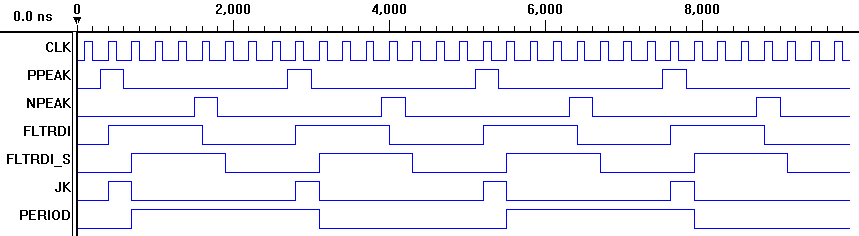
Click here to get the test vector file.
The bottom waveform (PERIOD) is a squarewave with the same frequency as the complex waveform coming from the microphone.
The bottom waveform (PERIOD) is a squarewave with the same frequency as the complex waveform coming from the microphone.

