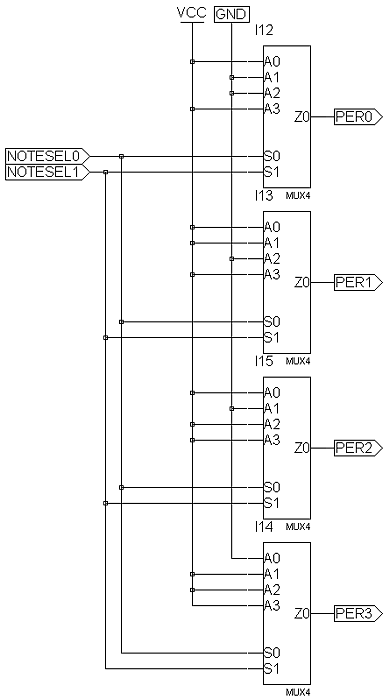
gk12-08 Note to Period Converter
15 points
OEES 235
|
|
|
Test_vectors
([NOTESEL1,NOTESEL0] -> [PER3,PER2,PER1,PER0]) [0,0] -> [.X.,.X.,.X.,.X.]; [0,1] -> [.X.,.X.,.X.,.X.]; [1,0] -> [.X.,.X.,.X.,.X.]; [1,1] -> [.X.,.X.,.X.,.X.]; |
| Inputs to this circuit are a binary
number representing a particular musical note. The outputs are a number
representing the period corresponding to the note specified by the
binary number on the inputs. The Note to Period Converter (NPC) will be used to output the period number for the note on the piano keyboard that is closest to the note coming from microphone. After the Shift to Highest Octave circuit has shifted the microphone frequency to the highest octave on the piano keyboard, a circuit will determine which of the twelve notes (C, C#, D, D#, E, F, F#, G, G#, A, A#, B) is closest to the note coming from the microphone. This note will be expressed as a binary number and then sent to the NPC, which will output the desired period number. The above schematic has only two inputs, so it would only be capable of creating periods for four notes. For the next project, you'll be creating a circuit capable of producing periods for all twelve notes. The MUX4 macros you see above are 4-bit multiplexers. This macro can be found in the C:\..\ispcpl\plsi\plsi\mux.lib library (second one from the bottom in the list you get when you click the ADD SYMBOL tool in the schematic editor's toolbox. Here are the directions for the present project.
|

