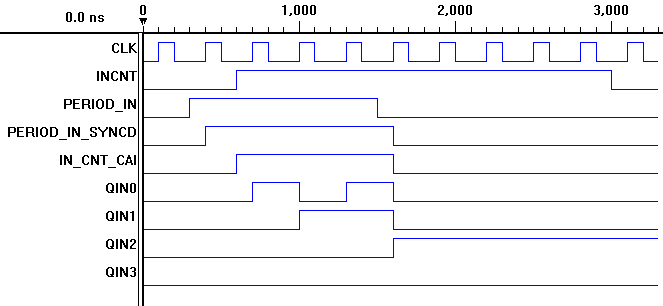
| INCNT | Input counter portion of the tone-translator's overall cycle. (There will also portions of this overall cycle reserved for operation of the octave shift-register and for the output counter.) At present, this signal goes high a short time after PERIOD_IN goes high, and stays high for eight clock pulses. In another experiment, we'll create circuitry to generate INCNT. For now, we'll simply treat INCNT as an input, and use the test vector to create it. At some point in the future, we'll have this signal stay high for a large number of clock pulses (to provide the resolution needed for musical tones). |
| PERIOD_IN | Period in. This signal is high for the length of time required for the sound waveform to complete one cycle. (There will also be a PERIOD_OUT signal later on in the project. It will either be the same frequency as PERIOD_IN or one or more octaves higher or lower, as controlled by the octave-shift buttons.) |
| PERIOD_IN_SYNCD | PERIOD_IN synchronized with clock. |
| IN_CNT_CAI | Input counter cascade input. Acts like an enable input for the counter. When the signal is high, the counter is allowed to count. This signal is derived from PERIOD_IN_SYNCD and INCNT. |
| QIN0 - QIN3 | Outputs from the input counter. Once the counter has stopped counting, the number it contains is representative of the sound's period. (Frequency is one divided by the period.) |
Directions:
- Use the following to create a circuit that will behave as shown above:
- D flip-flop
- 4-bit up-counter
- One gate
- Notes:
- The same clock pulse is used for the D flip-flop and for the counter.
- Download the test vector file.

