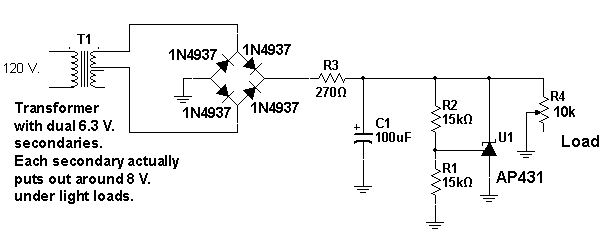
- Find the reference voltage on the AP431 data sheet: _______________
- Leave R1 at 15k. What value do you need for R2 to set the regulator for a 6 V. output voltage? _________________
- Connect the circuit using the value you calculated for R2 in the previous step.
- Double check to be sure the 270 ohm resistor has the cathodes of the two diodes connected to it. The cathode is marked by a white stripe.
- Double check the capacitor to be sure the negative end is connected to ground and the positive end is connected to the 270 ohm resistor.
- When you power up the circuit, check to be sure the transformer isn't getting hot. Also check the diodes and the regulator chip for heat. Unplug the transformer immediately if anything is getting hot.
- Turn the pot fully clockwise.
- Measure the output voltage (the voltage across the load resistor). If it is 0, turn the pot fully counterclockwise.
- Connect a scope to the output, and see if the output is close to being a straight line, as opposed to a line with a lot of ripple on it.
- If the output voltage isn't exactly 6 volts, put a 100k resistor in parallel with either R1 or R2, and see which position changes the output voltage in the right direction.
- By trial and error, replace the 100k resistor with one that will give you almost exactly 6 volts for the output voltage.
- Accurately measure the ripple with the scope: __________________
- Turn the pot halfway between fully clockwise and fully counterclockwise. What is the ripple? ____________
- The ripple should be more than what you measured in step 12. If it is about the same, turn the pot some more in the same direction until you do see some ripple, and write the ripple voltage here: ____________
- Notice that as you turn the pot, you finally reach a point where the output voltage starts to decrease. At this point, the load is at the lowest resistance that the power supply can handle.