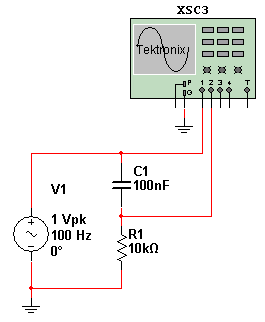
Calculate the phase angle and power factor for the circuit below. (We'll do this in the lecture room.)
Phase angle: _______________ Power factor: __________________
Part 2
- Connect up the circuit below.
- Center both sinewaves vertically so that their grounds are on the center line of the scope's screen.
- Adjust the scope's timebase to give you exactly one positive half cycle of channel 1's sinewave on the screen. (If necessary, use the timebase's variable adjustment knob.)
- One full sinewave cycle is 360 degrees, so half a cycle is 180 degrees. Divide 180 by the number of horizontal divisions on the scope's screen. This will give you the number of degrees per division.
- Determine how many divisions (to one decimal place) there are between the point where channel 1's sinewave crosses the horizontal center line and where channel 2's sinewave crosses it.
- In both cases you want the sinewave to cross from a negative voltage to a positive voltage as you go from left to right. In other words, you want positive slopes.
- Multiply the number of divisions by the number of degrees per division. This gives you the phase angle. Phase angle: ___________
- Take the cosine of the phase angle to give you the power factor. Power factor: ______________